

When shall the Zero Volt option be used?
The Zero Volt option extends the operating range of the electronic load to very low input voltages, when otherwise the load could not control the full current. The Zero Volt option is only available for ZS series DC loads. PLI series offers a model subset with integrated Zero Volt module (PLIxxxxZV).
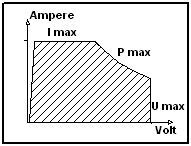
The Zero Volt option compensates for voltage losses and allows the operating of the device down to input voltages of a few millivolts. With this option the device allows the test of current limitation characteristics down to the total short-circuit. If the device is set to operating mode current and a higher load current is adjusted than the UUT can provide, the voltage of the unit under test collapses to 0V and the amperemeter shows the short-circuit current. For the operating mode voltage the load voltage can be adjusted down to 0V.
For operating mode resistance the resistance range is extended from the lower limiting value of any range to 0 Ohm. When the sense terminals are connected to the output terminals of the UUT, the short-circuit will be controlled up to the position where the sense terminals are connected with the output terminals of the unit under test. That means, even the resistance of the load cables is taken into account and compensated. To do so, the load terminals can become even negative (max. -0.5 V) to compensate the voltage loss on the load cables. Therefore a short-circuit over longer cables can be adjusted, which is not possible with power switches. The in-built watching of the polarity won’t produce a reversed polarity of the UUT.
Power reduction caused by Zero Volt option
When a device is extended with the Zero Volt option, a power reduction of the device has to be taken into account. See user manual how the power reduction is calculated.
After the installation of the Zero Volt option there may occur static voltages at the load input.
Displaying this negative voltage is permitted and doesn’t restrict the functionality of the device.